Community Safety Campaign Guide
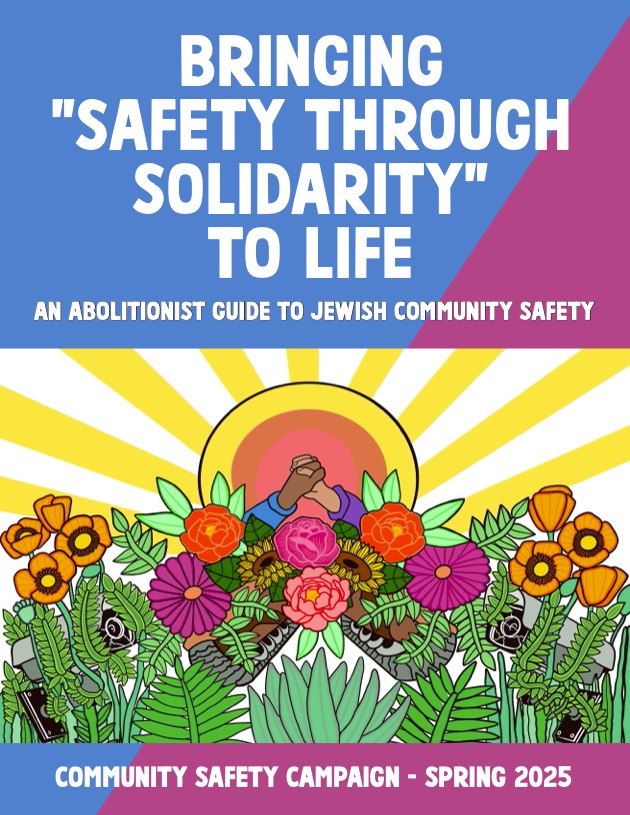
This document provides our beloved Jewish communities and non-Jewish partners with a guide for addressing one of the core challenges of our time – rising white supremacist and antisemitic violence.
We wrote this guide as an organizing tool, not simply as a text to be consumed. Our aim is to increase safety both within and beyond Jewish communities. We encourage you to engage with it in community rather than on your own.
The guide is a visionary and practical roadmap for our communities to transform their safety practices and participate in the wider movement for abolition. It offers concrete strategies, interventions, and tools; analysis of the conditions, threats, and challenges we face; and inspiring examples from communities already putting the values of “Safety through Solidarity” into practice.
“An urgent and necessary program, not just for Jewish communities but for all of us. The keyword here is solidarity, the recognition that our collective safety and well-being requires building new communities, new publics, new alliances and even new friendships. If we can do this, with open minds and hearts, with a commitment to accountability and care, then we’ll discover the most important lesson of all: an abolitionist guide to safety turns self-defense into a path toward liberation.“- Robin D. G. Kelley, scholar-activist and Distinguished Professor of U.S. History
“Bringing ‘Safety Through Solidarity’ to Life is an incredible gift to communities who are committed to safety and justice, across a wide spectrum of political commitments and religious expressions. Rooted in Jewish tradition and reaching towards the material realization of the world to come in our days, this report is a prophetic call to action and a strategic roadmap for our communities. I am looking forward to studying it and bringing it to life in my community.” – Rabbi Jessica Rosenberg, organizer and co-author of For Times Such as These: A Radical’s Guide to the Jewish Year
“This guide weaves together practical resources, compelling case studies, and visionary calls to action into a powerful resource for movement building. Its expansive framework for ‘community safety’ is an asset for anyone organizing for justice in these times.” – Zein Nakhoda, Training for Change
“Our movements have needed something like this for a long time, a comprehensive vision of a radical approach to community safety in all of its aspects. It gathers so much wisdom from across our movements all in one place, and offers a really wide range of tools and entry points for this work, ranging from political analysis to resources for campaign work, movement history, and much more. We on the Jewish Left talk about ‘community safety’ a lot and I’m so grateful this report does the work to rigorously develop the, concept, expand it to embrace its full scope and implications, and strategize what it would take to put it into practice not only locally but across our communal landscape and the wider society.” – Ben Lorber, co-author of Safety Through Solidarity: A Radical Guide to Fighting Antisemitism
CONTENTS OF THE GUIDE
INTRODUCTION & ACKNOWLEDGMENTS
CHAPTER 1: VISION
Guiding Question: What will our Jewish communities – and the wider world – look and feel like in 10 years if we achieve some or all of the goals we’ve articulated in this guide?
CHAPTER 2: PROJECT HISTORY
Guiding Question: Why did this team of Jewish organizers, political educators, and healers come together to embark on this project?
CHAPTER 3: INTRODUCTION TO OUR STRATEGY
Guiding Question: Why is it important that we invest our time, resources, and energy into both challenging how the current systems function and also into cultivating the systems we need in the world? What frameworks can help us take on this layered approach?
CHAPTER 4: STRATEGIC INTERVENTIONS
Guiding Question: What do we need to collectively prioritize, build, and experiment with to advance our goals?
CHAPTER 5: GUIDING ABOLITIONIST & JEWISH VALUES
Guiding Question: What are the political, cultural, and spiritual commitments and values, Jewish and otherwise, that guide our team’s collective response to the conditions we face?
CHAPTER 6: CURRENT & HISTORICAL CONTEXT
Guiding Question: What are the histories and current conditions that shape Jewish safety practices in the U.S.?
CHAPTER 7: STORIES OF BUILDING OLAM HABA (THE WORLD TO COME)
Guiding Question: What can we learn from inspiring examples – projects, campaigns, and organizations – that are powerfully actualizing the futures we need?
CHAPTER 8: STORIES OF RESISTING OLAM HAZEH (THE WORLD AS IT IS)
Guiding Question: What can we learn from inspiring examples – projects, campaigns, and organizations – that are powerfully resisting the harmful and violent systems we live in now?
CHAPTER 9: CLOSING THOUGHTS
Guiding Question: Now that we’ve completed the guide, what final reflections can help us to integrate this learning and begin to put it into practice?
CHAPTER 10: RESOURCES
Guiding Question: What are the resources we can share with our communities to advance this work where we are?
 Community Safety Campaign